
The recent catastrophic flash floods in Nepal, apparently triggered by the collapse of a glacier rock mass that sent ice, rock, and sediment downstream, causing a sudden surge of water and debris in the river, highlight the destructive power of such events.
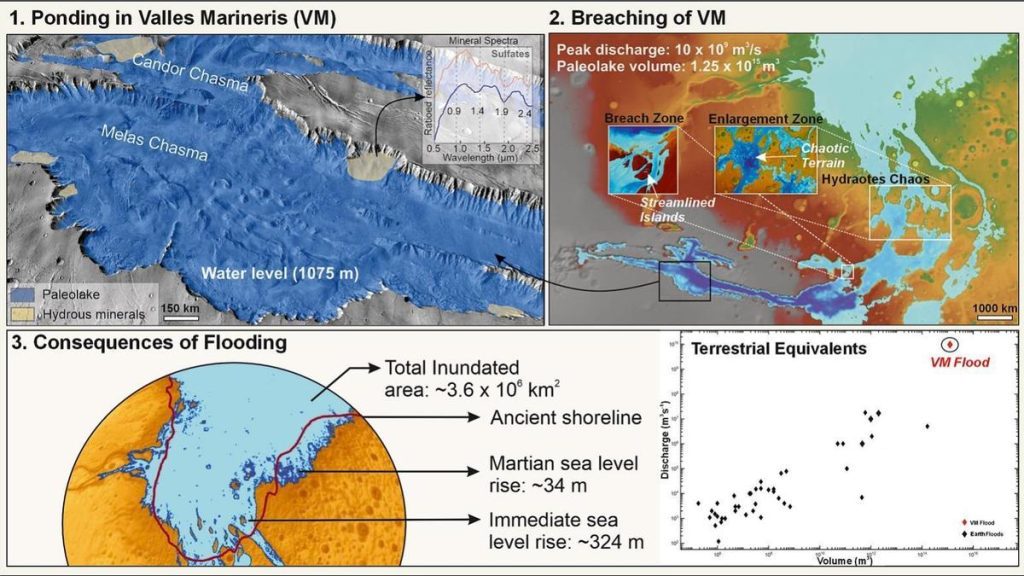
A vastly larger outburst flood occurred on Mars during the Late Hesperian to Early Amazonian, when the breaching of paleolakes in Valles Marineris, the largest canyon system in the Solar System, unleashed a massive deluge. The study was conducted by Sajin Kumar, assistant professor in the Department of Geology, University of Kerala, and his team, along with researchers from the Indian Institute of Space Science and Technology, Okayama University in Japan, and the University of Mississippi and Michigan State University, both in the United States. The researchers used two-dimensional hydraulic modelling to reconstruct the flood and assess its impact on the hypothesised ancient Martian ocean.
The flood, which originated in the ancient canyon system, is estimated to have released 1,245 trillion cubic metres of water and may have raised the global mean level of the hypothesised ancient Martian ocean by about 34 metres, according to a new study published online in the peer-reviewed journal Icarus . Valles Marineris stretches more than 4,000 km across Mars’s equatorial region and is thought to have once contained extensive bodies of water, including paleolakes. Researchers estimate that these waterbodies contained about 2,369 trillion cubic metres, with simulations suggesting that roughly half was released during the catastrophic breach.
