
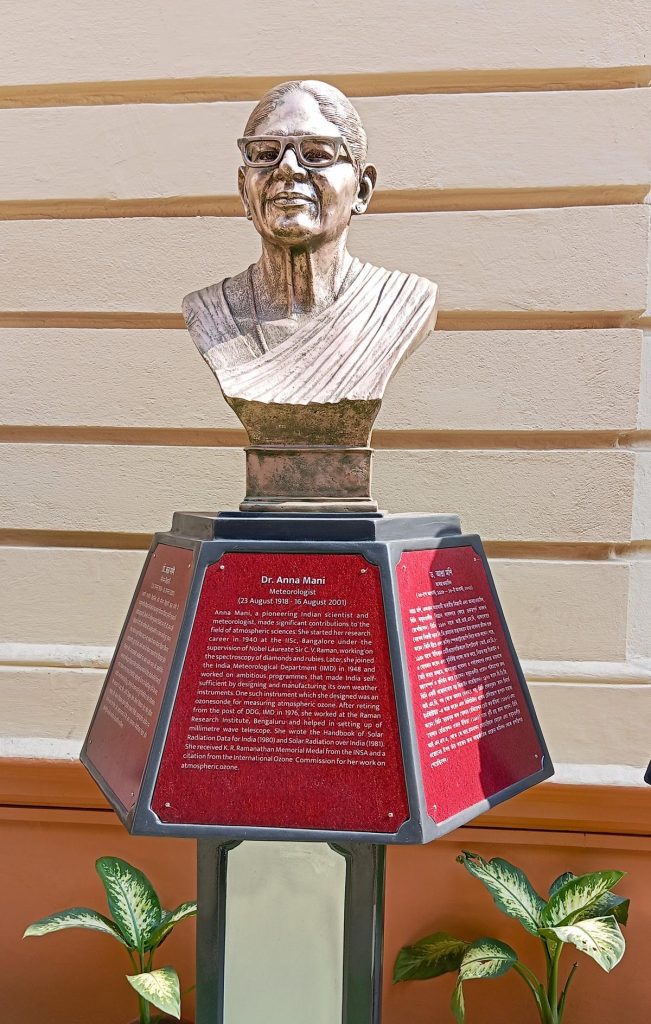
Little did anyone in the misty hills of Idukki know that one day the place would be known by the legacy left behind by her. This is the story of Anna Modayil Mani, the weatherwoman of India. In the high ranges of Peermade, Travancore (the current Peermade of Idukki district in Kerala), in 1918, a young girl was born to Modayil Pothen Mani, a well-known civil engineer cum plantation owner and his wife.
Her peer-reviewed research papers are often still cited in the field today. At a time when barely any women were formally educated and pursuing higher education, Anna not only completed her bachelor’s, but also went on to start her research at the Indian Institute of Science, Bengaluru, under Nobel Laureate Sir C.V. Raman. Still climbing the steps towards self-sufficiency post-independence, Anna played a huge role in helping the country become self-reliant in weather instruments. A department which heavily depended on imported instruments soon got recording rain gauges, hygrographs, thermographs, barometers, and anemographs. The journey was not easy, and Anna worked closely with the World Meteorological Organization to verify the accuracy of Indian instruments. All this while being one of the few women in the field.
This was in 1940, and she was working on spectroscopy ( the study of how matter interacts with electromagnetic radiation, or light) of diamonds and rubies. In 1948, Anna returned to India after her work in England and joined the India Meteorological Department in Pune. In 1953, she became the head of the instruments division, and under her, more than a hundred weather instruments were designed, standardised, and manufactured in the country.
She also published the Handbook of Solar Radiation Data for India and S olar Radiation over India, which, in a way, became the core reference for those designing solar thermal systems. She also conducted extensive wind speed surveys, laying the groundwork for India’s wind energy development decades before it became mainstream. She then went on to work at the Raman Research Institute and also collaborated with the Indian Institute of Tropical Meteorology to assess solar and wind energy potential for the Department of Science and Technology. She headed this project until almost the end of her life. She was also honoured by multiple international and national organisations for her work throughout the years.
In 1976, Anna retired as the Deputy Director-General of IMD after close to 7 years in the position.
