
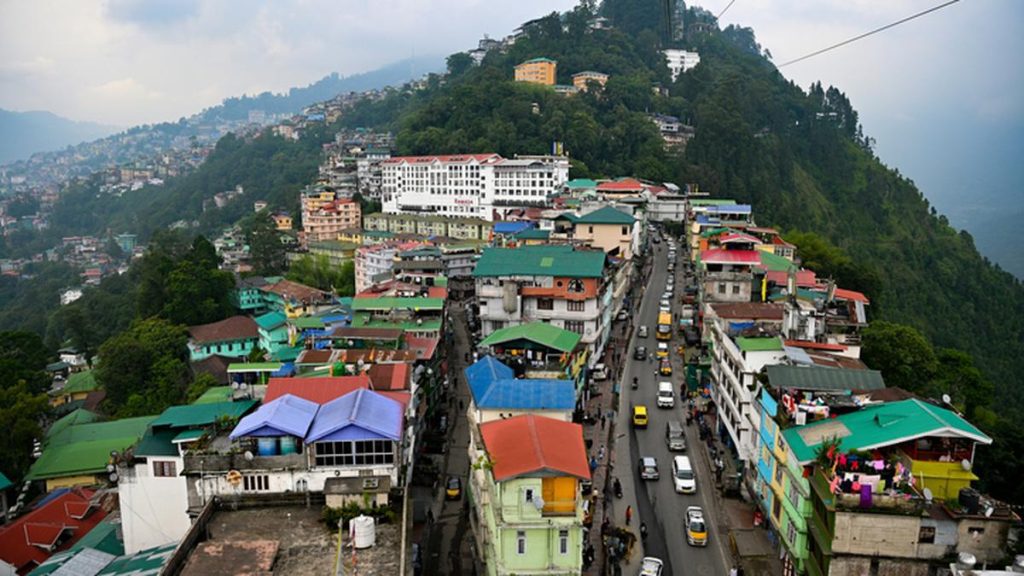
Sikkim has many attributes. It is India’s only fully organic State, its first Open Defecation Free (ODF) Plus model State, and all nine of its urban local bodies are certified ODF+, with Mangan bagging the ‘Promising Clean City Award’ at the Swachh Survekshan 2024-25.
The report was released during a two-day workshop on sustainable sanitation in Gangtok earlier in September. The National Faecal Sludge and Septage Management (NFSSM) Alliance conducted the study titled ‘Sunaulo, Samriddha, ani Samarth Sikkim: Strategic Pathways for Liquid and Used Water Management Report’ as part of its ongoing engagement with the State’s Urban Development. The study, however, notes the gap between toilet access and full sewerage connection. Sikkim’s terrain amplifies the rebuilding challenge. The study points to Uttarakhand, another Himalayan State that faced similar terrain constraints dealing with wastewater treatment. The study also documents Sikkim’s efforts to improve sanitation. It highlights collaborations on detailed project reports for faecal sludge treatment plants, bringing together the Rural Development, Urban Development, and Public Health Engineering Departments to pool technical and administrative capacity, financing, and land. The report touches upon the ecosystem Sikkim is building for public-private partnerships spanning technology, knowledge-sharing, and operations and maintenance support involving women-led self-help groups, civil society groups, and sector experts.
Only 40% of Gangtok’s 100,286 (Census 2011) population is connected to a piped sewerage network. Across the State, 11,880 households — almost half the total number—have any sewer connection at all. Citing NITI Aayog’s Urban Wastewater Scenario in India report four years ago, the study says that the country treats barely 28% of the 72,368 million litres of urban used water generated every day. This indicates that 72% of India’s sewage flows untreated into rivers, lakes, groundwater, and the seas. In 2023, Namchi district recorded a 242% spike in post-monsoon rainfall while neighbouring districts ran almost dry. Given Sikkim’s geography — with 84.4% of its 7.09 hectares under forest, the State has about 15% of land available for farming or building — the report prescribes decentralised, terrain-hugging treatment plants, not a huge one per town. Uttarakhand’s treatment capacity jumped by 180% in less than a decade—from 24 plants treating 152.9 million litres per day (MLD) in 2015 to 69 plants treating 428 MLD by 2024.
The State’s cascaded, landslide-prone terrain means treatment plants designed for “average” are overwhelmed in the wet season and underused during dry spells. The study says conventional, centralised sewage plants were not designed to handle such a mismatch.
