
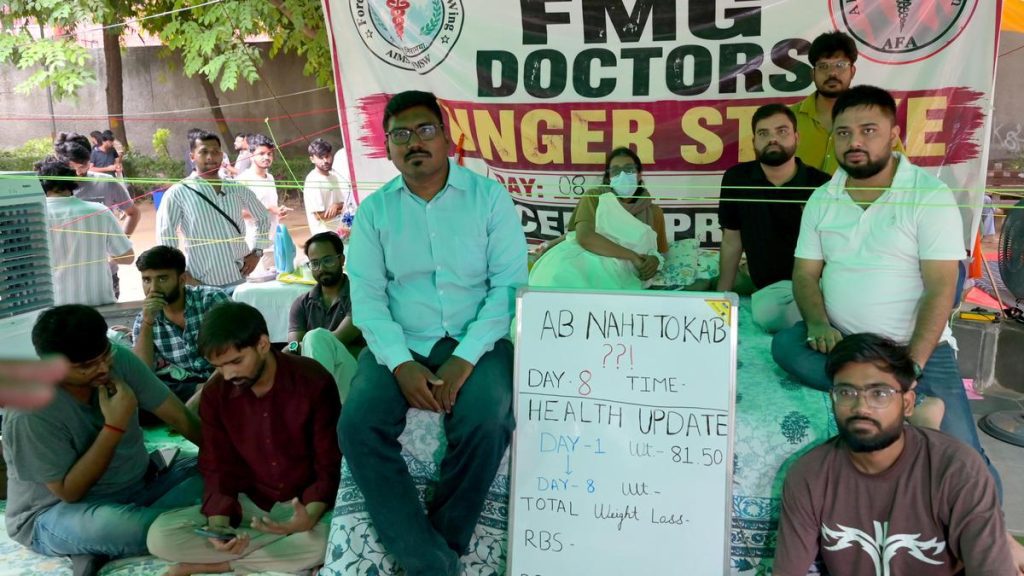
comprising a heavily monitored segment under the National Medical Commission (NMC) and the National Board of Examinations in Medical Sciences (NBEMS), parliamentary disclosures indicate that centralised tracking of specific discipline-wise student outflows remains complex While thousands of Indian students head overseas annually for medical degrees.
A look at the high-weightage sections — Community Medicine (PSM), Internal Medicine, and Obstetrics and Gynaecology — reveals distinct hurdles. Community Medicine heavily tests India-specific public health administration, including domestic health committees like the Bhore or Kartar Singh committees, local staffing norms at Primary Health Centres, and administrative schemes that foreign universities naturally omit. For a student trained overseas, this often translates to unfamiliar civic administration rather than core medicine. Conversely, Internal Medicine acts as a control case focused on universal clinical reasoning, ranging from ABG analysis to emergency cardiac protocols. Meanwhile, Obstetrics and Gynaecology balances international diagnostic criteria with clinical application, though candidate performance frequently hinges on interpreting embedded clinical images, manoeuvres, or diagnostic scans. Weighing these system dynamics, Dr. Samar Kumar, National FMG In-charge for the Federation of All India Medical Association (FAIMA), explains, “In departments such as Medicine, Surgery, and Obstetrics & Gynaecology, Indian hospitals generally see a very large number of patients. This gives doctors and students exposure to a wide variety of clinical presentations and allows them to learn how to manage patients even when resources are limited. I would particularly highlight Community Medicine… If an FMG studies Medicine, Surgery, Obstetrics & Gynaecology, and Community Medicine properly, focuses on clinical concepts, and practices clinical and image-based questions, they should find these areas much more manageable in the FMGE. The academic difficulty was further compounded by severe logistical hurdles on test day. Dr. Samar Kumar outlines the physical toll: “The first issue was related to examination centres. Multiple centres had inadequate facilities. Some did not have coolers or fans, and in some cases, even drinking water was not adequately available. As you know, the FMG examination is five hours, and overall it takes eight hours. Maintaining concentration in such tough conditions, especially during extreme summer, is something beyond the capacity of many students and FMG doctors particularly when they are not provided with adequate facilities. Clearing the exam is only the first milestone; graduates face a complex administrative labyrinth before they can practice. Dr. Abroad MBBS is a very long-term investment that many don’t realise initially. I think the integration into Indian healthcare and internship issues are the biggest challenges faced by FMGs.”
By the time you get PR [permanent registration], best-case scenario, approximately 8 years have gone by (including course duration) and a lot of money.
As the National Board of Examinations does not release official FMGE question papers, student-reconstructed “recall” papers serve as the baseline for preparation. Parvathy Sabu, who cleared the exam and works in a Government Hospital in Thiruvananthapuram, said, “Internship posts for FMGs are fewer across almost every State, and protests to increase seats are seen often…
