
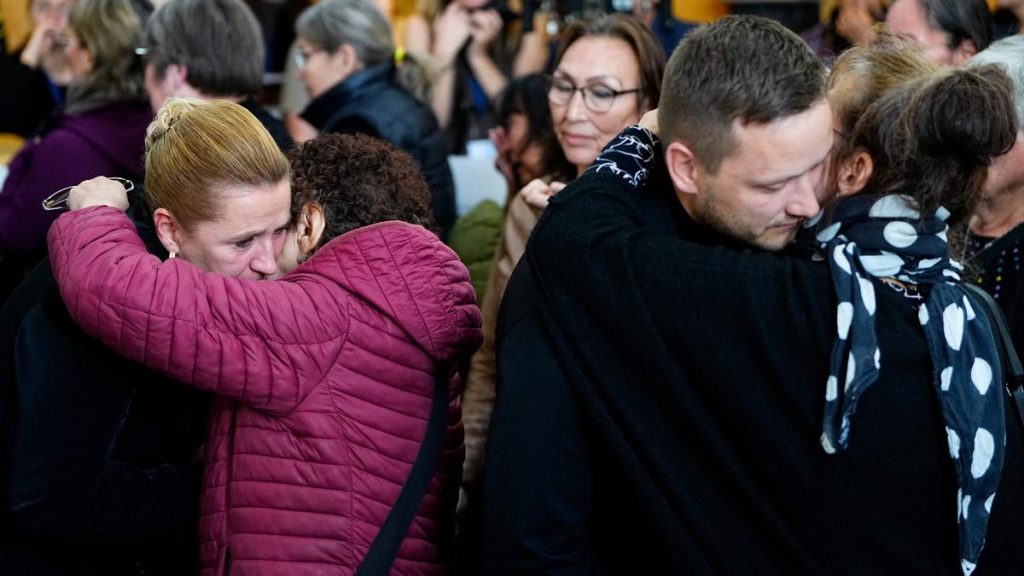
A Greenlandic commission is to present a highly anticipated report Friday to determine whether Denmark’s forced contraception of thousands of the Arctic island’s indigenous Inuit constituted a “genocide”.
Greenland, a Danish colony for three centuries and now an autonomous territory, still has a complicated relationship with Copenhagen. Despite many thorny issues between them, both Copenhagen and Nuuk have presented a united front rejecting US President Donald Trump’s threats to take over Greenland. He has repeatedly accused Denmark of treating Greenland badly. “There’s this pressure on the relationship so of course, when we start talking about genocide, that increases the pressure. “But everyone in Greenland has been very clear that this tragic case should not be used to legitimise other political purposes internationally. The commission’s four appointed experts were unable to agree on which approach to take and ended up writing two reports, submitted nearly six months behind schedule. “It was buried so deeply in my subconscious… Everything that happened to people is beyond imagination if you haven’t experienced it yourself,” she added.
Nathanielsen announced the creation of the commission, tasked with shedding light on the legal implications of the campaign, in August 2024 when she was Greenland’s minister of justice and gender equality. During the 1960s to 1990, more than 4,000 Greenlandic women were forced to wear a contraceptive coil — or intrauterine device (IUD) — in the vast majority of cases without their consent or that of their parents if they were minors.
“Everything that is happening between Denmark and Greenland now is scrutinised,” said historian Astrid Andersen, a researcher at the Danish Institute for International Studies (DIIS). “I realised everything it had cost me — all those hospitalisations, those surgeries, the schooling I missed and, above all, those pains I had never associated with that damn IUD,” said Kirstine Najarak Berthelsen. That would make it possible to “acknowledge what happened”, according to the 68-year-old psychologist.
Not just about history
On Thursday, the Danish parliament agreed that women affected by the forced contraception campaign can claim compensation from Copenhagen, an initiative pushed by Prime Minister Mette Frederiksen who presented Denmark’s official apology last year. “For me, this is not just about history or politics. “And once again, I see that it is others who will investigate and define what was done to me and to other Inuit women. Nuuk and Copenhagen are also shedding light on several other painful chapters from the past, including children adopted without parental consent or torn from their families. Media coverage of the case has revived trauma that had been buried for decades.
Because of the United States’ aggressiveness toward Greenland, “Others may feel that we should simply keep quiet about this and try to be conciliatory,. The forced contraception campaign between the 1960s and 1990 is one of the darkest chapters in Greenland’s history with its former colonial master, Denmark. The campaign affected girls as young as 12, some of whom were never able to have children afterwards.
“For us, it’s about trying to understand our history,” Naaja Nathanielsen, a member of parliament representing Greenland in Denmark’s parliament, told AFP. One of the victims, Henriette Berthelsen, told AFP the conclusions, regardless of what is decided, were skewed from the start since no Greenlandic Inuit were appointed as experts. It’s my body, my life, and my right to self-determination,” she said.
Once the conclusions are presented, Greenland’s government will decide how to move forward. The scandal came to light when one of the victims spoke out in the media about the trauma she experienced. The Danish government is considering the idea.
By the late 1970s, one in two Greenlandic women of childbearing age — at least 4,070 women — had been fitted with an IUD, according to an investigation presented in September 2025. A podcast series in 2022 then revealed the full extent of the campaign.
Henriette Berthelsen has called for a “Truth and Reconciliation” commission to be established. “I believe that only then will we be able to begin to heal and move forward — not as adversaries, but as human beings and as peoples equal in dignity.”
