
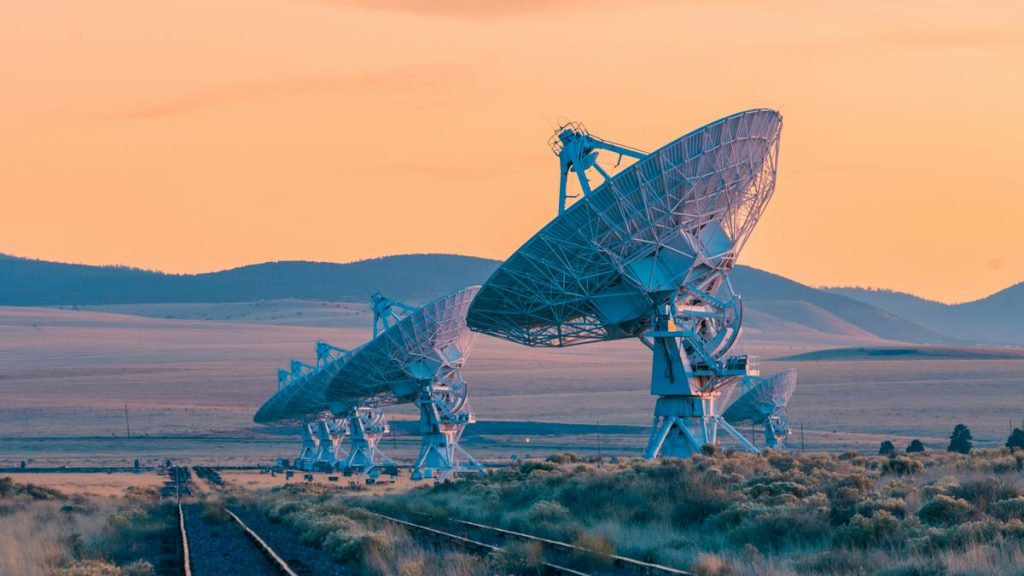
Communications satellites in low-earth orbit are emitting radio signals that interfere with astronomy across a range of frequencies, a study published in Monthly Notices of the Royal Astronomical Society has reported. The findings, reported under a satellite radiation monitoring programme called SNIFFLES, suggest protecting the interests of astronomers requires operators to regulate licensed transmissions as well as stray radiation from onboard electronics.
The study’s authors concluded that operators could adopt existing international rules about radio transmissions through the atmosphere to control emissions from satellites in earth orbit. They also called for operators, satellite designers, and space agencies to continuously monitor emissions, especially as direct-to-cell services expand via private enterprises like Starlink and Amazon Leo. The study authors used the Mopra radio telescope and the Australia Telescope Compact Array to track satellites of the Starlink, OneWeb, and China’s Guowang constellations across nearly 376 hours from April 2024. The authors also found a signal from the OneWeb constellation at 1,613.19 megahertz (MHz) that could get in the way of telescopes studying hydroxyl ions (–OH – ) in space. They also reported radiation at 2,700 Hz appearing in nearly 77% of observations from a specific version of Starlink satellites.
