
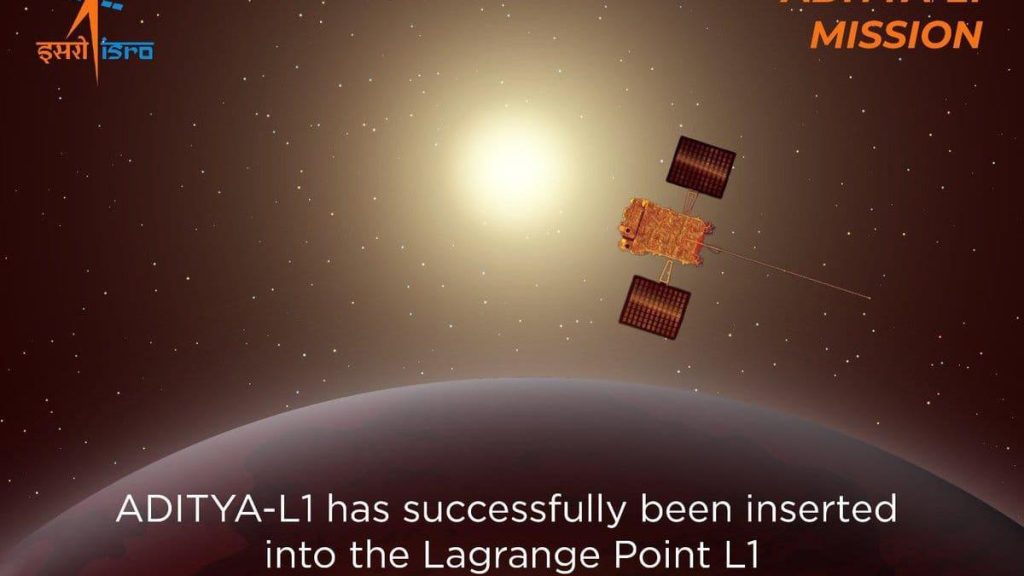
In a first, scientists from Bengaluru and their international collaborators have analysed scientific observations of solar eruptions and studied the coronal mass ejections (CMEs) by using data derived from India’s Aditya-L1 mission and Europe’s Proba-3.
ISRO stated that these joint observations provide deeper insights into CME evolution than observations from a single spacecraft. The estimated magnetic energy is comparable to, or greater than, the kinetic energy. The results demonstrate the scientific potential of synergetic ASPIICS and VELC observations to constrain the CME mass, density, and energetics in the inner corona, thereby providing new observational constraints on the early evolution of CMEs. The study shows that pairing a coronagraph that images the corona with one that measures its spectrum yields a more complete, cross-checked view of the origin and evolution of CMEs,” ISRO stated.
Scientists at the Indian Institute of Astrophysics (IIA) combined observations from the Visible Emission Line Coronagraph (VELC) payload onboard Aditya-L1, and the Association of Spacecraft for Polarimetric and Imaging Investigation of the Corona of the Sun (ASPIICS) payload onboard Proba-3 to study the mass, density, and energetics of these CMEs in the region very close to the Sun. “In the September 14 CME, thermal energy was only about 1% of the total. In the September 16 CME, thermal energy grew until it matched kinetic energy. The Aditya-L1, which is India’s first dedicated solar mission, was launched by PSLV-C57 on September 2 2023. The Proba-3, a mission of the European Space Agency (ESA), was launched by PSLV-XL from Sriharikota December 5, 2024. Two spacecraft are about 150 metres apart, and one casts a shadow on the other.
