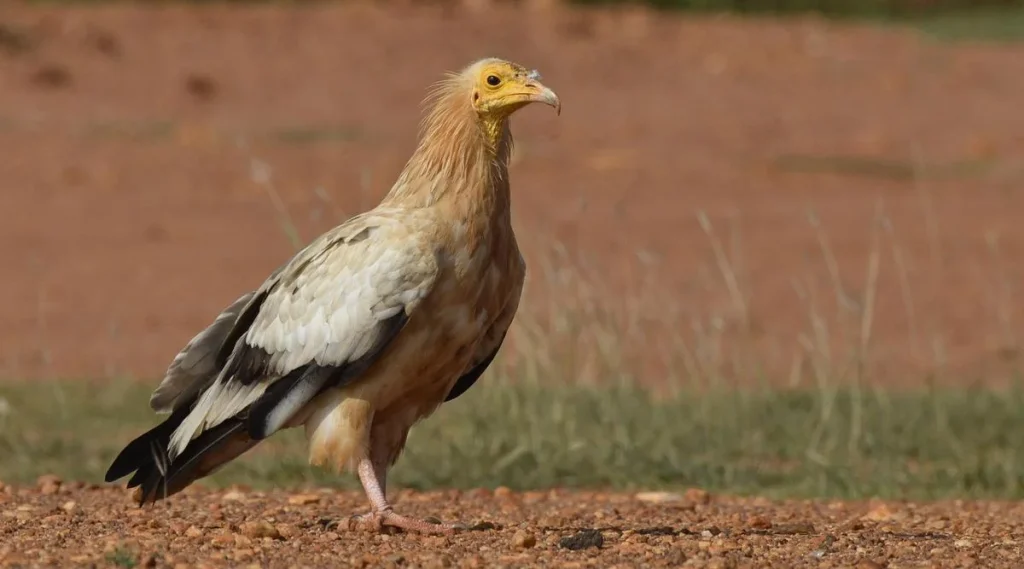
Once familiar in villages, temple towns, grazing lands and rocky cliffs across south India, the Egyptian Vulture (Neophron percnopterus) has almost disappeared from much of its range. In less than a century, the species has become locally extinct in The Nilgiris and no longer breeds in Tamil Nadu. Conservationists now warn the remaining resident population in south India is facing increasing pressure, highlighting the urgent need for coordinated conservation efforts including the establishment of an Egyptian Vulture Conservation Breeding Programme in the State.
Event Context
“There have been records of these birds in the Kota villages around Kotagiri and Ketti till a few decades ago,” said Mr. Vasanthan, adding historical records also mention Long-billed Vultures in Udhagamandalam.
Even in recent decades, breeding and roosting populations have persisted in parts of Mysuru, Bandipur, Ballari, Raichur and, most notably, the rocky hill ranges of Ramanagara. Surveys conducted during 2013–2014 recorded an average of about 12.3 Egyptian Vultures, including adults, sub-adults and juveniles, around Ramadevarabetta in Ramanagara, highlighting its importance as one of the last remaining strongholds of the species in peninsular India.
Team Analysis
The Egyptian Vulture is one of the world’s smallest vultures and is globally listed as Endangered by the International Union for Conservation of Nature (IUCN). It is distributed across southern Europe, northern and central Africa, the Middle East, Central Asia and the Indian subcontinent. India is home to the resident subspecies Neophron percnopterus ginginianus, while migrant birds from Africa and the Middle East also visit the country during winter.
“Our estimate is that fewer than 150 resident Egyptian Vultures remain across Karnataka and Tamil Nadu,” he said. “Many Egyptian Vultures seen in south India during winter are migratory birds arriving from Africa and the Middle East, but the resident breeding population is now extremely small and requires immediate conservation attention,” he said.
Karnataka presently supports the most important remaining resident breeding populations of the Egyptian Vulture in south India. Records dating back to the late 19th century describe the species as widespread across the State, occurring from Sakleshpur and the Kanara plains to Mysuru, Chitradurga, Bengaluru, Kolar and the Biligirirangan Hills.
In Tamil Nadu, although resident breeding populations have disappeared, wintering migrant Egyptian Vultures continue to be recorded from Chennai, Tirunelveli and Koonthankulam Bird Sanctuary, where seasonal counts of 10–17 individuals have been documented, said Mr. Samson. “These observations demonstrate that Tamil Nadu continues to provide suitable wintering habitat for the species, even though confirmed breeding populations are no longer known from the State,” added Mr. Samson.
Match Outlook
S. Bharathidasan, secretary of Arulagam, a conservation NGO, said that there were unconfirmed reports of a single nesting pair that still clings on to survival in Tamil Nadu, but added that for all intents and purposes, that the Egyptian vulture is “functionally extinct” in the State, adding that a combination of factors, including the use of rodenticide and other toxins could have contributed to the species’ demise. “Of all the vulture species in India, the Egyptian Vulture is probably among the most threatened and in need of immediate protection,” said Mr. Bharathidasan.
Conservationists believe that adapting this proven model for the Egyptian Vulture, together with habitat protection, safe food availability, mitigation of electrocution and poisoning risks, and continued collaboration among the Forest Departments of Tamil Nadu, Karnataka, Andhra Pradesh and Telangana, scientists, conservation organisations and local communities, could provide a strong foundation for the long-term recovery of this endangered scavenger.
source
Historically, the species played a vital ecological role by removing animal carcasses from the landscape and helping maintain healthy ecosystems, while also sharing a unique cultural association with several communities and temple traditions across peninsular India, according to vulture experts.
Records reveal the species was once remarkably abundant across the Nilgiris and adjoining landscapes. British ornithologist William Ruxton Davison, states in Notes on some birds collected on the Nilghiris and in parts of Wynaad and Southern Mysore (1883) that, “This species (Egyptian Vulture) is very abundant on the Nilghiris [sic], but especially so within the station of Ootacamund and about the Badaga villages in its vicinity.” Davison also described the birds as remarkably fearless, allowing people to approach them closely while feeding.
Further historical records reinforce its former abundance. Primrose (1904) documented Egyptian Vultures from the Nilgiris and Wayanad. A rare photograph taken in 1906 by Edgar Thurston, published in Ethnographic Notes in Southern India, depicts Egyptian Vultures being fed by temple priests at the Vedagiriswarar Temple at Tirukazhukundram, illustrating the bird’s long-standing cultural association with local communities.
In 2008, K.V.R.K. Thirunaranan, founder of The Nature Trust, Chennai, photographed an adult Egyptian Vulture with a chick at Devarabetta, Thally, Tamil Nadu, confirming the species continued to breed in south India until relatively recently.
Egyptian Vulture seen at the Hessarghatta grassland in Bengaluru on February 28, 2016. | Photo Credit: K. Murali Kumar
Author of Birds of The Nilgiris: A Historical Account (1839–2025), P.J. Vasanthan, said Kota communities, renowned for their traditional leather-working practices, unintentionally created ideal feeding opportunities for vultures through the availability of livestock carcasses which allowed them to thrive until recently in areas such as The Nilgiris.
Despite once being one of the most widespread vultures across Tamil Nadu, the Egyptian Vulture has become the first vulture species to disappear locally from The Nilgiris. Multiple factors have contributed to its decline, including the use of veterinary non-steroidal anti-inflammatory drugs (NSAIDs) such as diclofenac, electrocution associated with expanding power infrastructure, accidental poisoning, disturbance of nesting cliffs and gradual changes in traditional livestock-rearing practices that reduced the availability of natural food resources.
Mr. Vasanthan noted socio-economic transformation among pastoral communities in The Nilgiris also contributed to the decline, as many households gradually shifted away from traditional cattle rearing towards settled agriculture, reducing the number of livestock carcasses available for scavenging birds.
According to Arockianathan Samson, centre manager, Bombay Natural History Society’s Vulture Conservation Breeding Centre, Bhopal, currently there are no known active breeding sites of the Egyptian Vulture in Tamil Nadu.
Recent observations from neighbouring Andhra Pradesh further reinforce these concerns. Wildlife experts warned the species is approaching local extinction in the Rayalaseema landscape. Researchers reported that the species has declined sharply due to habitat degradation, electrocution on power lines, shrinking food resources, accidental poisoning and increasing human disturbance around nesting cliffs. Experts have called for scientific population surveys, protection of nesting habitats, installation of bird diverters on hazardous power lines, establishment of vulture-safe feeding zones and greater community awareness to safeguard the remaining birds.
Recognising the urgent need for conservation intervention, the Bombay Natural History Society (BNHS) presented a proposal and approached the Tamil Nadu government to establish an Egyptian Vulture Conservation Breeding Programme during the Tamil Nadu Raptor Research Foundation (TNRRF) Expert Committee Meeting.
The proposal highlighted the rapid decline of the species across south India and recommended the establishment of a dedicated conservation breeding facility in Tamil Nadu. Based on habitat suitability, historical distribution and the availability of suitable cliff ecosystems, potential locations include The Nilgiris, Dharmapuri, Krishnagiri, Coimbatore and other suitable landscapes.
The proposal builds upon BNHS’s successful conservation breeding programmes for Gyps vultures in Haryana, West Bengal, Madhya Pradesh and Assam, where internationally recognised expertise has been developed in artificial incubation, chick rearing, veterinary care, behavioural management and post-release monitoring.
